
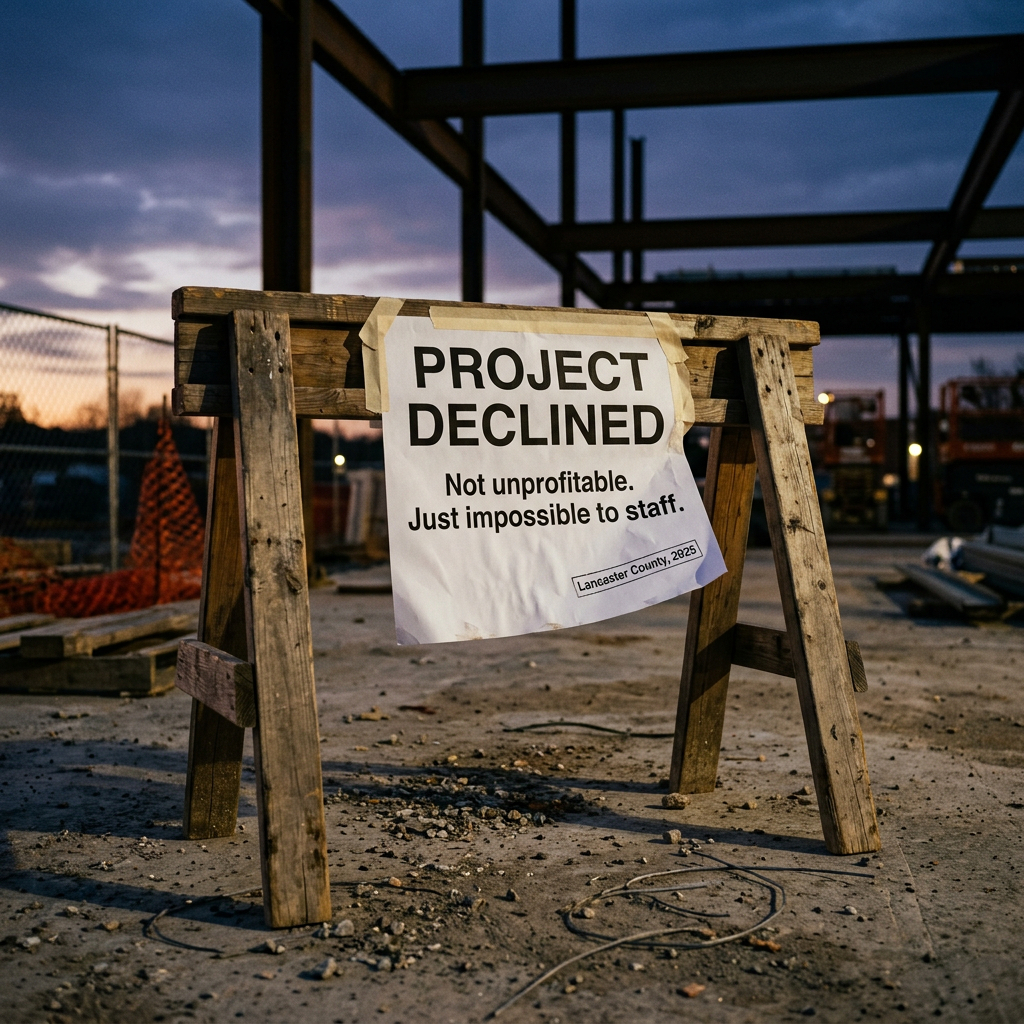
I know of companies in Lancaster County that are turning down work.
Not because the projects aren’t profitable. Not because they lack equipment or capital. They’re refusing revenue because they don’t have enough qualified people to run the jobs.
That’s not a labor shortage. That’s a crisis hiding in plain sight.
The Numbers Tell a Stark Story
Pennsylvania’s electrician density sits 22% below the national average. Lancaster County feels this acutely.
The unemployment rate hit a historic low of 3.8% in July 2025. Online job postings for all occupations spiked 80.6% from July 2024 to July 2025. Every company is competing for the same shrinking pool of workers.
Electricians here earn between $61,986 and $70,622 annually. Top earners reach $92,811. The wages are competitive because the talent simply isn’t there.
But the real pressure comes from what’s ahead.
Lancaster’s workforce is aging. We’re looking at a projected 60% increase in retirees by 2030. Nationally, nearly 30% of union electricians are at or close to retirement age.
The math is brutal. About 10,000 electricians retire or change careers annually. Only 7,000 new ones enter the field. That’s a net loss of 3,000 workers every single year.
The Skills Mismatch Nobody Talks About
It’s not just about having warm bodies on job sites.
Many new workers enter the trade while experienced ones leave. Newcomers often lack technical experience outside basic residential and commercial work. Heavy commercial, light industrial, and heavy industrial tasks are completely different animals.
The gap exists between general commercial skills and the specialized needs of industrial projects.
Many electricians can run EMT conduit for retail spaces. But few have experience threading rigid conduit or certifications for explosion-proof environments. These aren’t minor distinctions. They’re the difference between getting a contract and watching it go to someone else.
Research shows that 77% of construction firms report that available candidates lack the skills needed to work in the industry or can’t pass required certifications.
This creates a push-and-pull dynamic. Companies with complex jobs compete for limited high-level talent. The workforce gap isn’t just about quantity. It’s about having the right people for the right complexity level.
Strategic Triage Becomes the New Normal
When companies turn down work, they’re making calculated decisions.
Large projects that could damage their reputation if they can’t deliver successfully get declined. Small projects that won’t significantly impact the bottom line get passed over too.
The decision depends on current capacity and team skills. If there’s an employee in training who can handle small to medium projects, they might proceed. Without that person, they refuse the work.
This is strategic triage. Companies are rationing their workforce, choosing which opportunities deserve their limited talent pool.
The impact cascades beyond individual businesses. Construction labor shortages now cause 45% of project delays across the industry. More critically, 58% of project owners have canceled, postponed, or scaled back projects due to increasing costs driven by labor scarcity.
New construction projects and large-scale manufacturing expansions in Lancaster County are creating intense competition for a shrinking pool of qualified workers. The region’s growth ambitions are bumping against workforce reality.
The Pipeline That Isn’t Flowing
Not enough younger workers are entering the trades to replace retiring ones.
Only 16.7% of Gen Z high school and college students express interest in careers like becoming an electrician. This represents a dramatic cultural shift toward four-year college degrees at the expense of vocational training.
Previous generations readily entered the trades immediately after high school. That pathway has narrowed considerably.
Trade schools and vocational-focused community colleges saw a 16% rise in student enrollment in 2023 compared to 2018. That sounds encouraging until you realize the Bureau of Labor Statistics projects we need 80,000 new electrician positions filled annually through 2031.
The increase falls catastrophically short of meeting demand.
From Waiting to Developing
Forward-thinking companies in Lancaster are making a fundamental shift.
They’re no longer waiting for qualified workers to come to them. They’re developing their own workforce.
I believe they’re sticking to the traditional route of enrolling apprentices in programs through organizations like the IEC, ABC, and trade schools. The infrastructure exists. The apprenticeship model works when properly executed.
But something else is emerging.
Companies are beginning to recognize the importance of intentional leadership and mentorship from experienced workers to apprentices.
The Intentionality Gap
From what I observe, there’s often an expectation that apprentices will naturally learn and grow by being part of a project.
That holds some truth. Osmosis happens. People pick things up.
But intentional leadership and mentorship are what actually transfer deep expertise. Experienced electricians need to take the time to teach apprentices properly, rather than assuming they already know how to do everything.
This is where the real solution lives.
Most electricians learn through a 4- or 5-year apprenticeship program that includes 2,000 hours of paid on-the-job training annually plus technical instruction. The pandemic disrupted this hands-on training model significantly. Trades can’t be learned remotely through online courses.
The training pipeline bottleneck created a larger gap that persists today.
What’s different about intentional mentorship compared to how it traditionally happened? The assumption changes.
Traditional mentorship was passive. You worked alongside someone and absorbed knowledge. If you didn’t pick it up, that was on you.
Intentional mentorship is active. Experienced workers deliberately structure learning experiences. They explain the why behind the how. They create space for questions. They check understanding before moving forward.
It sounds simple. It’s actually revolutionary in practice.
The Stakes Are Higher Than We Think
The electrical workforce is projected to shrink by 14% by 2030. Demand could increase by as much as 25% over the same period.
That widening gap threatens infrastructure development, renewable energy transitions, and AI data center expansions that require massive electrical infrastructure investments.
Lancaster sits at the intersection of these trends. The region has growth momentum. Manufacturing is expanding. Construction projects are multiplying.
But momentum means nothing without the people to execute it.
Companies are already making triage decisions about which projects to pursue. As the workforce continues to age and retire, those decisions will become more frequent and more painful.
The solution isn’t complicated. It requires intentionality.
Apprenticeship programs exist. Training infrastructure is in place. What’s missing is the deliberate transfer of knowledge from experienced workers who are approaching retirement to newer workers who need that expertise.
Companies that recognize this and build intentional mentorship into their operations will have a competitive advantage. They’ll develop the specialized talent that everyone else is competing for.
Those that don’t will keep turning down profitable work because they lack the people to do it.
The crisis is here. The question is whether we’ll respond with the same intentionality we’re asking of our mentorship programs.