
Most job seekers in Pennsylvania’s skilled trades market are looking in all the wrong places.
They scroll through endless job boards. They chase the biggest signing bonuses. They apply to companies with the flashiest ads.
Meanwhile, the truly elite employers operate differently. They don’t need to shout. They don’t need to bribe. Their reputation does the recruiting for them.
I’ve spent years observing this market, and the difference between genuinely superior employers and well-marketed mediocrity is stark. With Pennsylvania needing 300,000+ skilled workers by 2030, understanding these differences has never been more critical.
The Pull vs Push Dynamic
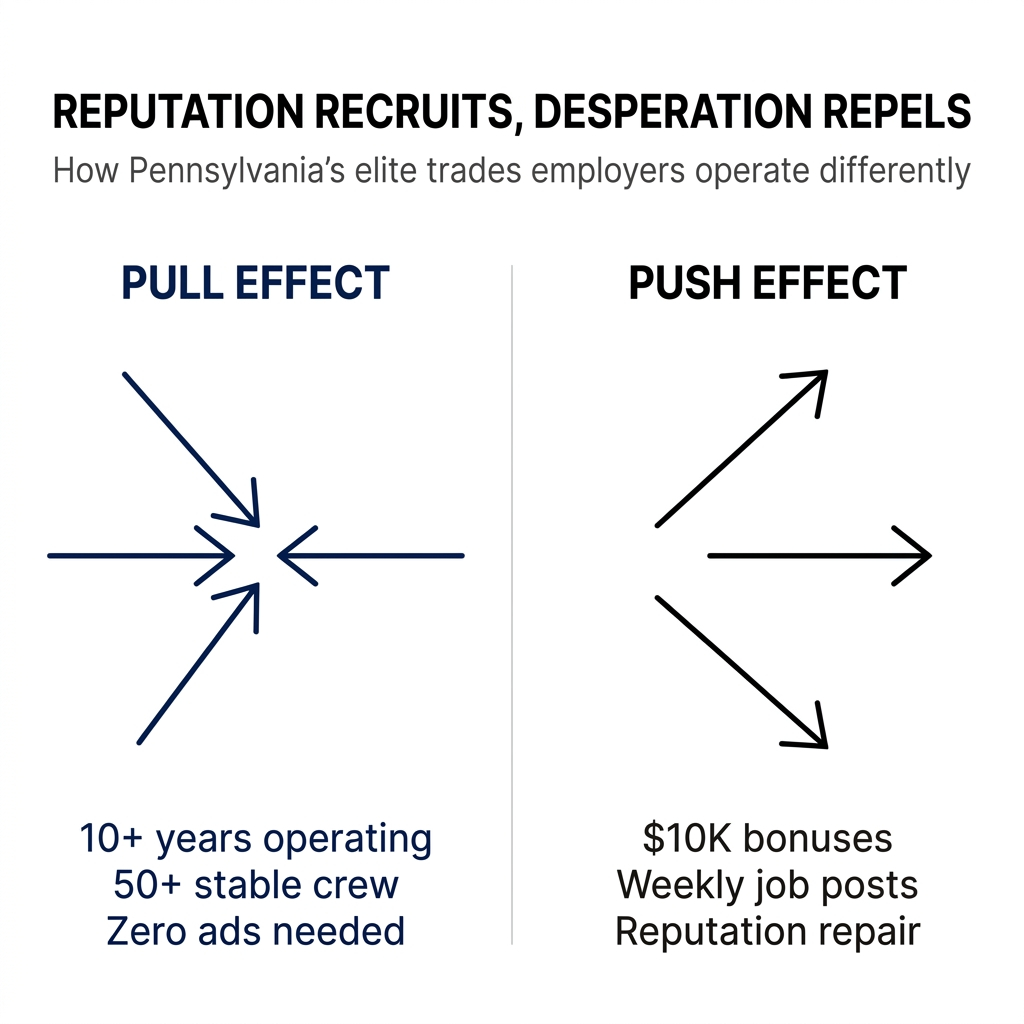
Elite employers create what I call a “pull” effect. Workers actively seek them out.
In my interviews, I notice a clear pattern. Job seekers ask, “Can we be put on a project with XYZ company?” They know the reputation. They value the commitment to safety and fair treatment.
These companies inspire people to want to join them. They genuinely attract talent through authentic operations, not marketing tricks.
Companies that rely solely on marketing create a “push” effect. They motivate through temporary incentives. You see this when contractors post countless ads, offer massive bonuses, and actively fight against bad reputations.
The push effect is always temporary. The pull effect builds over decades.
The Longevity Test
The first indicator I look for is longevity. A company that’s survived over 10 years has proven something fundamental.
They’ve weathered market ups and downs. They’ve adapted to political changes. They’ve managed seasonal fluctuations. That kind of endurance tells you they have a solid foundation.
But longevity alone isn’t enough. The second indicator is workforce stability.
A company that consistently maintains over 50 field employees isn’t just lucky. They have a culture that keeps people safe, respected, and working. When you combine longevity with workforce stability, you get companies whose reputation does the recruiting.
The Advertising Red Flags
Desperate companies reveal themselves through their advertising patterns.
The most obvious sign is seeing the same exact ad for the same position week after week. If they can’t fill a role after multiple postings, there’s a retention problem.
Ads that lead with huge signing bonuses and over-the-top incentives are compensating for something. Usually a bad reputation or poor work environment.
Elite companies rarely advertise at all. When they do, the messaging is straightforward. No gimmicks. No desperate appeals. Just clear job requirements and fair compensation.
The contrast becomes obvious once you know what to look for.
What Elite Job Sites Actually Look Like
Walk onto any job site and you’ll know within minutes what type of company you’re dealing with.
The first thing I notice is overall safety and organization. Elite companies create well-structured, clean environments. Materials are properly stored. Equipment is well-maintained. Everything has its place.
The second indicator is crew morale. A smoothly run site has a calm, purposeful vibe. Workers move with intention, not panic. Communication flows clearly between team members.
Chaotic sites feel different immediately. Rushed workers. Disorganized materials. Equipment that’s clearly not maintained properly. The stress is palpable.
These operational differences aren’t accidents. They stem from fundamental business practices that separate elite employers from the rest.
The Bidding Strategy That Changes Everything
Here’s what most people don’t understand: that calm, purposeful job site atmosphere starts with proper project bidding.
Elite employers know their value. They don’t shortchange themselves to win projects. They build reputations that back up their pricing. Their clients often award them projects when they’re not the lowest bidder because they’re the better contractor.
This creates healthy margins that allow competent foremen to manage projects and crews without stress. Well-aligned, top-down processes create collaborative atmospheres on the ground.
Companies that consistently underbid create the opposite effect. Thin margins force speed over quality. Foremen manage through stress instead of competence. The chaos trickles down to every worker on site.
The bidding strategy reveals everything about how a company operates.
The Evidence That Wins Premium Contracts
When elite companies aren’t the lowest bidder but still win projects, they present specific evidence that justifies premium pricing.
Jobs get completed on time and on schedule. They’re methodical in project execution. Well thought out approaches replace shooting from the hip.
They avoid multiple change orders that lesser contractors use to make up for oversight. Everything is done right the first time. The track record speaks for itself.
This creates a virtuous cycle. Better planning leads to better execution. Better execution builds reputation. Better reputation commands premium pricing. Premium pricing enables better planning.
The Pennsylvania Advantage
Pennsylvania’s current market conditions favor skilled workers like never before.
At Williamson College of the Trades, 114 employers compete for just 265 graduates annually. The competition for trained talent is fierce.
This gives workers unprecedented leverage to choose elite employers over mediocre ones. Why settle for chaotic job sites and thin margins when premium employers are actively recruiting?
The apprenticeship route offers particular advantages. 93% of apprentices secure jobs after completion, and they receive wages and benefits from day one.
Elite employers use apprenticeship programs strategically. They build long-term talent pipelines instead of constantly recruiting from a shrinking pool.
Union vs Non-Union Realities
The union versus non-union decision impacts more than just wages, though union workers do earn 11.2% higher wages on average.
Union positions offer structured advancement paths and standardized safety protocols. The training is comprehensive. The benefits are typically superior.
Non-union work provides different advantages. Individual rate negotiation. Direct client relationships. Potentially higher earnings for exceptional performers.
Elite employers exist in both categories. The key is identifying companies that prioritize worker development regardless of union status.
The Future Outlook
Pennsylvania’s skilled trades shortage will intensify before it improves.
Retiring baby boomers are leaving faster than new workers enter. High demand will continue forcing employers to compete aggressively for talent.
This trend favors workers who can identify elite employers early. Companies with strong reputations, stable workforces, and proper operational practices will offer the best long-term career prospects.
The employers posting desperate ads today will likely struggle tomorrow. The ones quietly building reputations through excellent operations will thrive.
Making the Right Choice
Elite employers in Pennsylvania’s skilled trades don’t announce themselves with flashy marketing. They prove themselves through consistent operations, worker retention, and client satisfaction.
Look for longevity combined with workforce stability. Observe job site organization and crew morale. Research their bidding practices and client relationships.
Ask yourself: Does this company pull talent through inspiration, or push through desperation?
The answer reveals everything you need to know about your potential employer.
In Pennsylvania’s current market, skilled workers have choices. The elite employers are worth finding.